
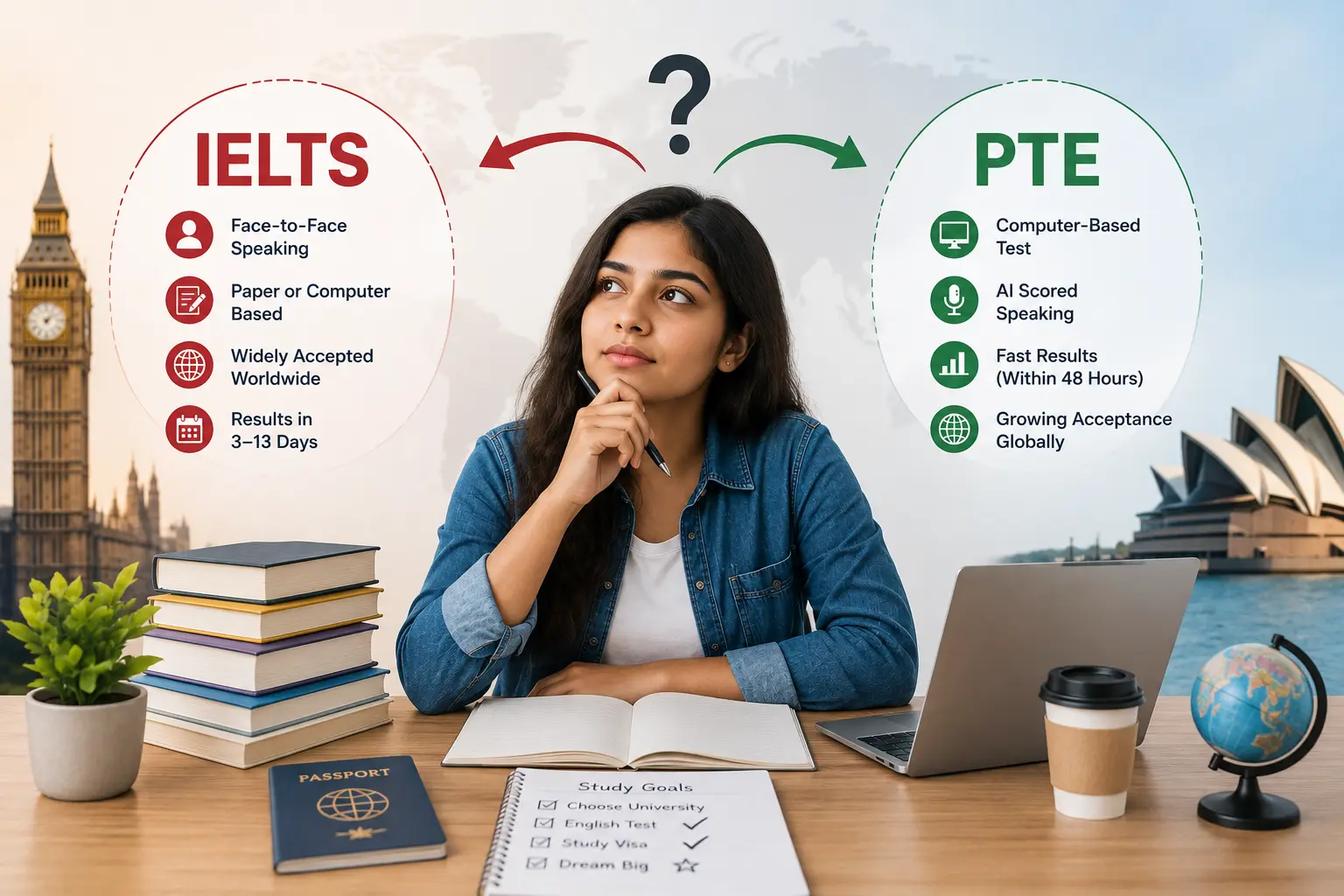
Picking an English test feels like a small decision. It isn’t. Your score can open a university door or close it. If you’re weighing IELTS or PTE for study visa applications, you can see thousands of Kerala students face this same fork in the road every intake season.
This guide breaks down both tests in plain language, what you need to decide and decide fast, so you can start your application with confidence.
Every university and every visa office have its own rules. Some accept only one test. Others accept both. Get this wrong and you could lose weeks re registering for a different exam.
Choosing the right English test for overseas study isn’t just about your comfort with speaking or typing. It’s about matching your target country, your course and your visa category. A mismatch here can delay your entire application.
IELTS has been around for over three decades and it shows in its reach. It’s accepted by thousands of institutions worldwide, including nearly every university in the UK, Canada, Australia and New Zealand.
The test uses a band score system from 0 to 9, with most universities asking for 6.0 to 7.0 overall. Reading and listening are computer or paper based. Writing follows the same format. But speaking is different. You sit across from a real examiner and have a live conversation.
Some students find this reassuring. A real person can follow your train of thought, even if you stumble on a word. Others find it nerve wracking, especially if they’ve never done a formal interview before.
One more detail worth knowing: the UK’s UKVI and Canada’s IRCC Express Entry pathway accept only specific IELTS versions. If your goal is the UK or Canada, IELTS is usually your safest bet.
PTE Academic runs entirely on computer. Every section, including speaking, is scored by automated scoring technology. There’s no examiner in the room. You speak into a microphone and the software evaluates your response.
Scores range from 10 to 90 and most universities ask for 55 to 65. Many students like PTE because results usually arrive within 48 hours. That speed matters when you’re racing against an application deadline.
PTE acceptance has grown fast in recent years. Over 3,000 institutions now recognise it, including many in the US, UK, Australia and Canada. Australia’s Department of Home Affairs accepts PTE for every student visa subclass, so it works smoothly if Australia is your destination.
Still, PTE hasn’t caught up to IELTS everywhere. Some UK and Canadian visa pathways don’t accept it at all. Always review your chosen university’s language proficiency requirements before making your final decision.
Here’s how the two tests stack up on the details that matter most:
Neither IELTS nor PTE is objectively easier. The ideal choice depends on your language skills and comfort with the test format. If you’re confident speaking to a person, IELTS may suit you. If you type faster than you talk and want quick results, PTE could be the better fit.
For student visa applicants in Kerala, the choice usually comes down to destination and timeline. Students heading to the UK or Canada typically need IELTS. Those applying to Australia, or to certain US and Canadian universities, often have the flexibility to choose PTE.
Timing also matters. Kerala students applying for the September intake should ideally sit their English test 8 to 10 months in advance, allowing time for retakes if needed. For the January intake, starting in June or July gives you a comfortable buffer.
Your course level plays a role too. Postgraduate and professional programmes sometimes demand higher band scores than undergraduate ones. Check your shortlisted university’s exact requirement before booking your test date.
Many students pick a test simply because a friend took it. That’s risky. Your friend’s target university might accept a test yours doesn’t.
Others wait too long to book, then scramble before the intake deadline. Retakes cost time and money, so preparation matters as much as the test itself.
A few students also underestimate speaking practice, assuming reading and writing carry more weight. Every section counts equally toward your final score, so balanced preparation pays off.
Choosing between IELTS and PTE shouldn’t feel like guesswork. At J&A, we carefully assess your study destination, course requirements and English proficiency to recommend the language test that best fits your needs. Our academy in Kochi and Pandalam runs structured IELTS, PTE and OET coaching designed around real intake deadlines.
Whether you’re aiming for the September or January intake, starting early gives you room to prepare, retake if necessary and still file your visa on time.
Ready to find out which test fits your goals? Schedule a free assessment with our counsellors today and take the guesswork out of your study visa journey.
Our team is ready to guide you. Reach out today, and we’ll provide the support you need for migration, manpower, education, or training services.